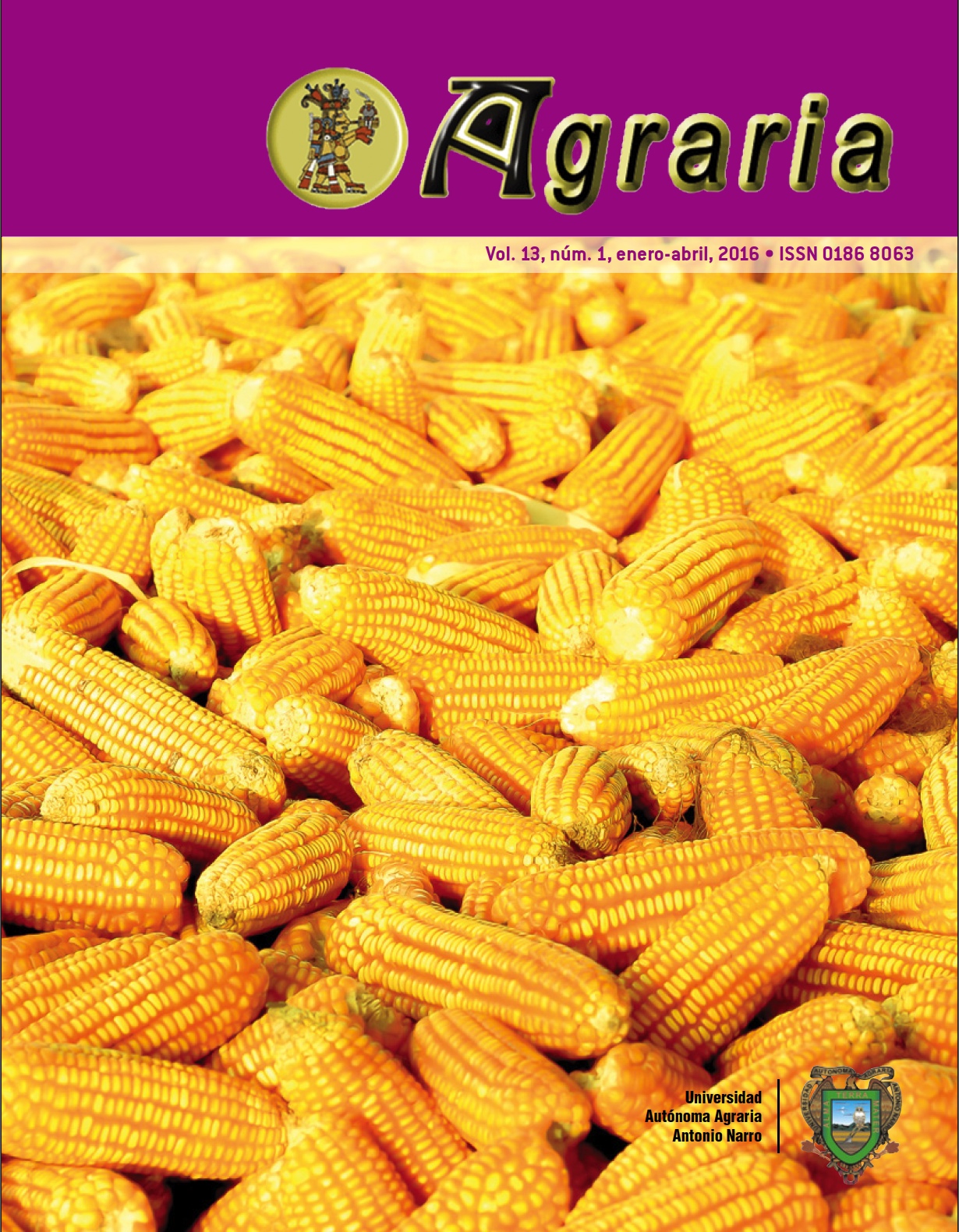
Genetic potential and adaptation of native maize populations southeast of Coahuila, Mexico
DOI:
https://doi.org/10.59741/agraria.v13i1.574Keywords:
Zea mays L, native populations, southeast of Coahuila, grain yieldAbstract
The southeast of the state of Coahuila has a high genetic diversity of maize. Knowledge of this genetic variation may be useful for plant breeding. The objectives of this research work were to determine the agronomic performance and yield potential of 63 maize populations of the southeast of Coahuila and to determine the area of adaptation and potential selection for the conditions of the southeast of Coahuila, Mexico. The agronomic evaluation of the 63 populations and seven checks included in the study (Spring-Summer 2013), was carried out in three environments: in El Mezquite, Galeana, N. L. (1910 msnm), General Cepeda, Coah. (1457 msnm), and in Jagüey de Ferniza, Saltillo, Coah. (2100 msnm). The results showed differences (P ≤ 0.01) among locations, genotypes and the genotype x location interaction for the traits evaluated. Also, among populations, checks and the populations vs checks comparison, there were differences (P ≤ 0.01) in male flowering and yield grain. The analysis of the genotype x environment interaction identified three genotype groups according to their adaptation: the first with 29 genotypes (41.43%) with adaptation to El Mezquite. The second group with adaptation to General Cepeda, with 24 genotypes (34.29%), and third group with 17 genotypes (24.28%), were considered stable across the two environments. The 38_T, 52_T, 54_T, 13_R and 40_R populations had similar yields to the best improved checks. Besides to specific adaptation of populations to locations, were identified four populations (28_CN, 27_CN, 59_TN and 56_R) with good yield potential and stable across environments. The 52_T, 54_T, 55_T, 33_EO and 35_R populations with good yield potential in high valleys; and 4_EC, 17_EC, 48_CN and 7_CN, populations, thrive well in the intermediate location.
Downloads
References
Andrade, F. H., A. G. Cirilo, S. Uhart y M. E. Otegui. 1996. Ecofisiología del cultivo de maíz. Buenos Aires, La Barrosa y Dekalb Press. 292 pp.
Babić, V., M. Babić and N. Delić. 2006. Stability parameters of commercial maize (Zea mayz L.) hybrids. Genetika. 38(3): 235-240. DOI: https://doi.org/10.2298/GENSR0603235B
Barreto, H. J., G. O. Edmeades, S. C. Chapman, J. Crossa. 1997. The alpha lattice design in plant breeding and agronomy: Generation and analysis. In: G. O. Edmeades, M. Bänzinguer, H. R. Mickelson, and C. B. Peña-Valdivia (Eds.). Developing Drought and Low N Tolerant Maize. Proceedings of a Symposium. March 25-29, 1996. México, cimmyt, El Batán, pp. 544-551.
Bellon, M. R. and J. Berthaud. 2004. Transgenic maize and the evolution of landrace diversity in Mexico. The importance of farmers ́ behavior. Plant physiology 134: 883-888. DOI: https://doi.org/10.1104/pp.103.038331
Clawson, D. L.1985. Harvest security and intraspecific diversity in traditional tropical agriculture. Economic Botany. 39(1): 56-67. DOI: https://doi.org/10.1007/BF02861175
González, C.M.E., N. Palacios R., A. Espinoza B. y C. A. Bedoya S. 2013. Diversidad genética en maíces nativos mexicanos tropicales. Rev. Fitotec. Mex. 33(6): 329-338. DOI: https://doi.org/10.35196/rfm.2013.3-S3-A.329
Hallauer, A., R. y B. Miranda. 1981. Quantitative genetics in maize breeding. Iowa State University Press. Ames, IA. 468 pp.
Hernández, C., J. M. y G. Esquivel E. 2004. Rendimiento de grano y características agronómicas en germoplasma de maíz de valles altos de México. Rev. Fitotec. Mex. 27(1): 27-31. DOI: https://doi.org/10.35196/rfm.2004.Especial_1.27
Herrera, C., B. E., F. Castillo G., J. J. Sánchez G., R. Ortega P. y M. M. Goodman. 2000. Caracteres morfológicos para valorar la diversidad entre poblaciones de maíz en una región: caso la raza Chalqueño. Rev. Fitotec. Mex. 23: 335-354. DOI: https://doi.org/10.35196/rfm.2000.2.335
IRRI. 2007. CropStat for Windows versión 7.2. (International Rice Research Institute). Metro Manila, Philippines.
Kato Y., T. A., C. Mapes S., L. M. Mera O., J. A. Serratos H., R. A. Bye B. 2009. Origen y diversificación del maíz, una revisión analítica. Universidad Nacional Autónoma de México, Comisión Nacional para el Conocimiento y uso de la Biodiversidad. México, 116 pp.
Márquez S., F. 2005. Consideraciones generales sobre el mejoramiento de maíces criollos. In: Memoria de la Primera Reunión de Mejoradores de Variedades Criollas de Maíz en México. Márquez O., L. F. (ed.). Exhacienda Nazareno, Xoxocotlán, Oax. 22-23 de septiembre, 2005. Centro Regional Universitario Sur, Universidad Autónoma Chapingo. Sociedad Mexicana de Fitogenética, pp. 153-162.
Nájera C., L. A., F. Rincón S., N. A. Ruiz T. y F. Castillo G. 2010. Potencial de rendimiento de poblaciones criollas de maíz en Coahuila, México. Rev. Fitotec. Méx. 33(4): 31-36. DOI: https://doi.org/10.35196/rfm.2010.Especial_4.31
Ortega P., R. A. 1985. Descripción de algunas razas mexicanas de maíz poco estudiadas. In: Variedades y razas mexicanas de maíz y su evaluación en cruzamientos con líneas de clima templado como material de partida para fitomejoramiento. Traducción al español por el autor. Tesis de Ph. D. Instituto Nacional de Plantas N. I. Vavilov. Leningrado, urss.
Paliwal R., L. 2001. El maíz en los trópicos: Mejoramiento y producción. Organización de las Naciones Unidas para la Agricultura y la Alimentación (fao). Roma, Italia. 376 pp.
Rincón, S., F., F. Castillo G. y N. A. Ruiz T. 2010. Diversidad y distribución de los maíces nativos en Coahuila, México. SOMEFI. Chapingo, Méx. 116 p.
sagarpa-siap. 2013. Anuario Estadístico de la Producción Agrícola. Servicio de Información Agroalimentaria y Pesquera (siap), Secretaria de Agricultura, Ganadería, 14 Agraria. Vol. 13, núm. 1, enero-abril, 2016 Espinosa-Tamayo et al. Desarrollo Rural, Pesca y Alimentación (sagarpa). Disponible en línea: http// www.siap.gob.mx
sas Institute. 2004. sas/stat ® 9.1 User’s Guide. Cary, NC: sas Institute Inc. USA. 1521 p.
Yan, W., and N. A. Tinker. 2006. Biplot analysis of multienvironment trial data: Principles and applications. Canadian Journal of Plant Science. 86: 623-645. DOI: https://doi.org/10.4141/P05-169
Wellhausen E., J., L. M. Roberts y E. Hernández X., en colaboración con P. C. Mangelsdorf. 1951. Razas de maíz en México, su origen, características y distribución. Oficina de Estudios Especiales. Secretaría de Agricultura y Ganadería. Folleto Técnico 5. México, D. F. 237 p.
Zobel, R., W., M. J. Wright and H. G. Gauch. 1988. Statistical analysis of yield data. Agron. J. 80: 388-393. DOI: https://doi.org/10.2134/agronj1988.00021962008000030002x
Downloads
Published
Issue
Section
License

This work is licensed under a Creative Commons Attribution-ShareAlike 4.0 International License.
How to Cite
PLUMX Metrics